



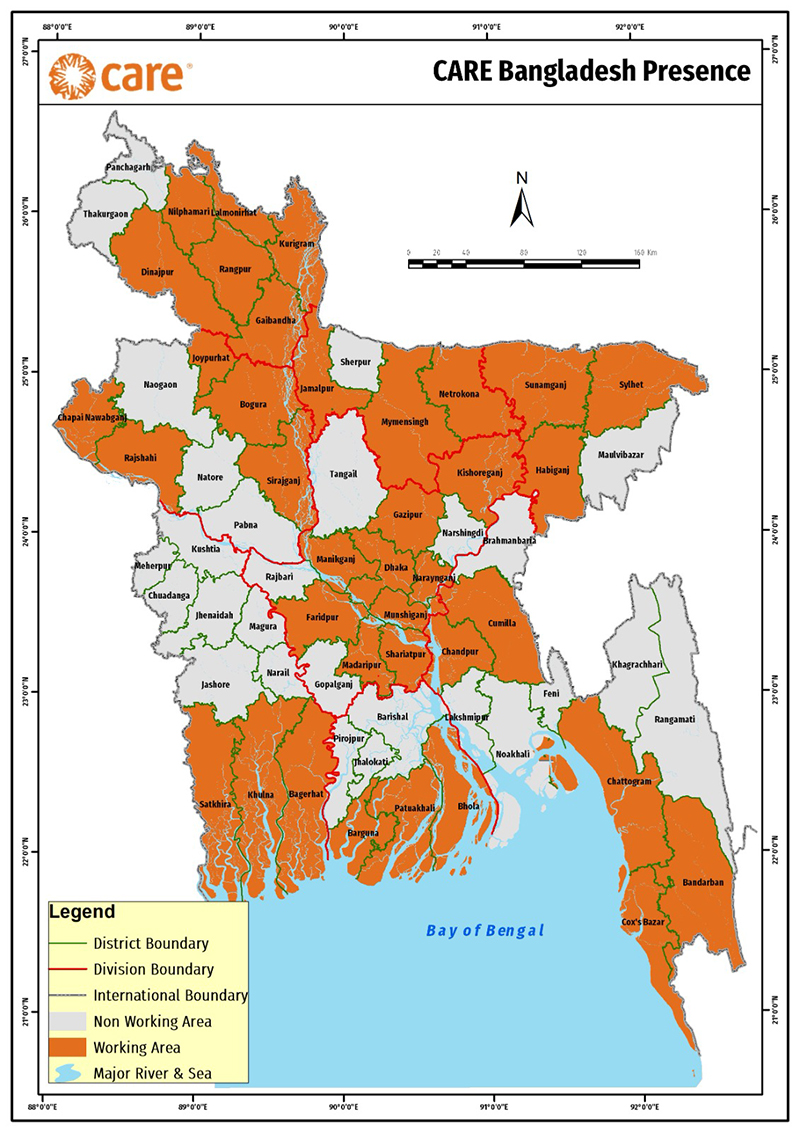


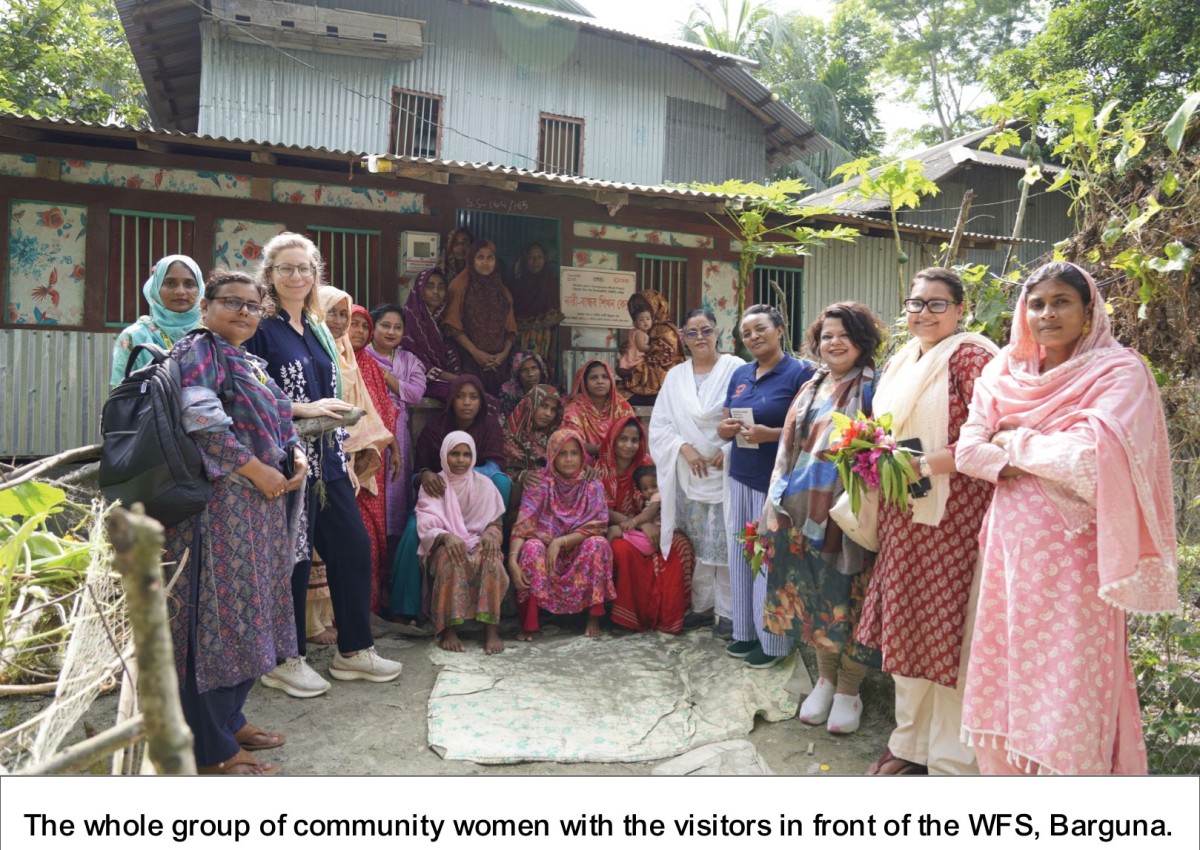
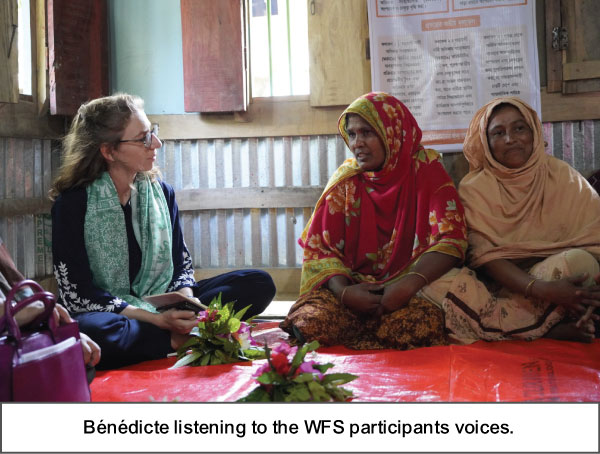
From November 4 to 6, a team from CARE Bangladesh, led by Emebet Menna, Deputy Country Director – 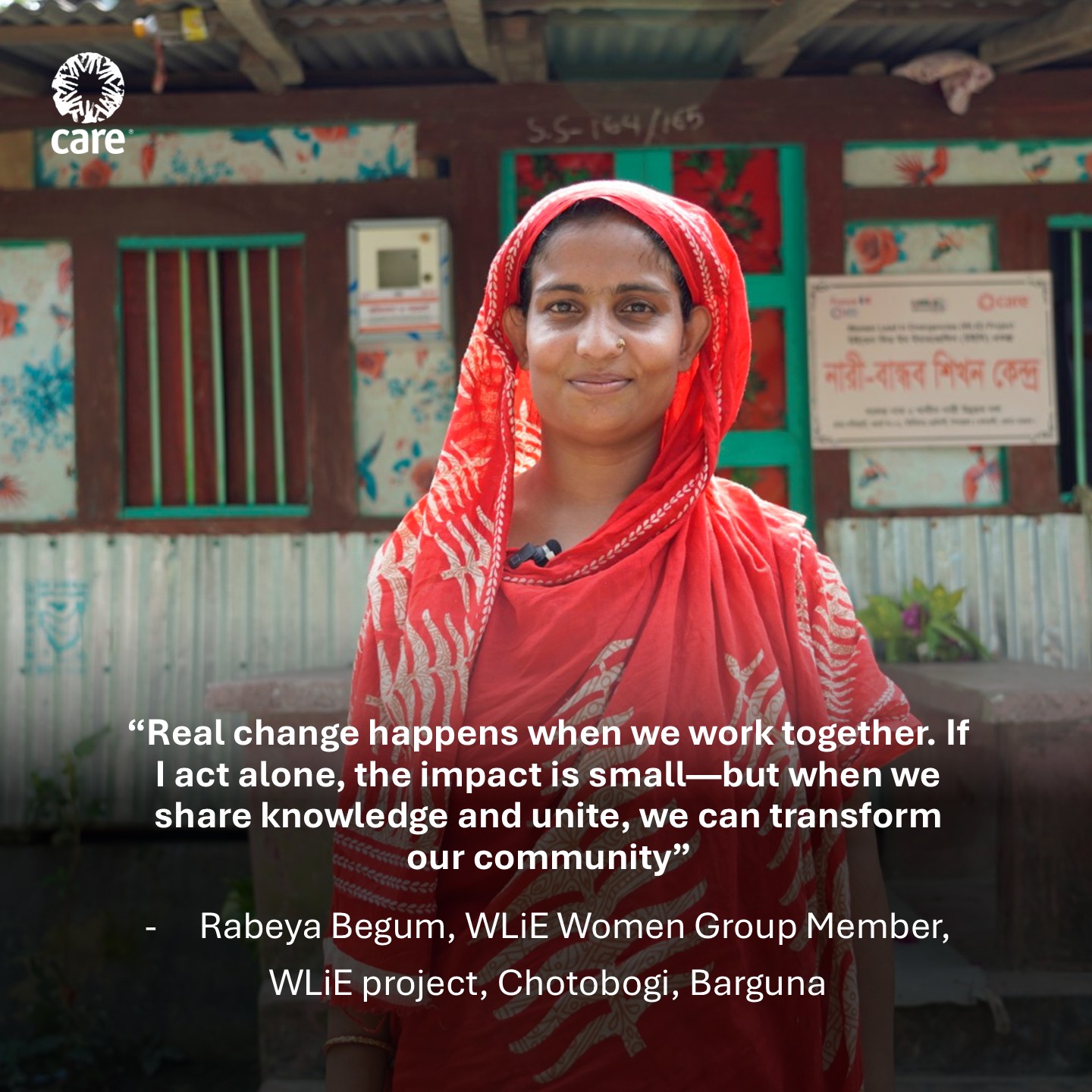 Programs, accompanied by Bénédicte Ginestet (representative from Agence Française de Développement [AFD]), and Rawnak Jahan, Director – Women and Youth Program, visited Barguna district to observe interventions under the Women Lead in Emergencies (WLiE) project. The visit aimed to understand how these initiatives are fostering leadership and resilience among women in disaster-prone communities.
At first, the team visited a Women-Friendly Space, which is a one-story establishment that accommodates around twenty-five people. 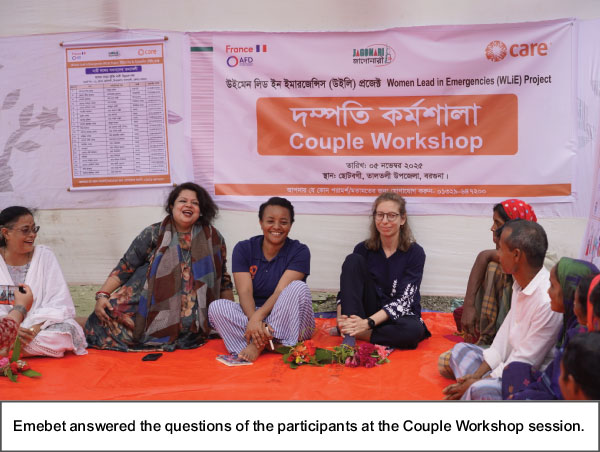 The facilitator was conducting a session on Problem Tree Analysis. Around twenty-one women from the community participated spontaneously in the exercise, where they identified their common problems, outlined the difficulties they encounter in their communities and families, and discussed probable solutions. The conversation uncovered recurrent problems like the continuation of traditional gender roles, and the improper valuation of women's opinions in domestic decision-making. The active discussion and debate around potential solutions clearly signaled that the participants had become more aware and conscious of their rights and obligations. By providing spaces for open discussion, and capacity-building, these forums help women ascend from their traditional roles and make significant contributions to decisions affecting their families and communities.
Emebet Menna, shared her remark on the visit, “Standing by the river just seven kilometers from the Bay of Bengal, it’s easy to imagine how devastating cyclones can be for these communities. Through the Women Lead in Emergencies program, women are finding their voice—identifying problems, setting priorities, and taking the lead to ensure their communities are better prepared for disasters.”
After this, the team moved to see the second session. 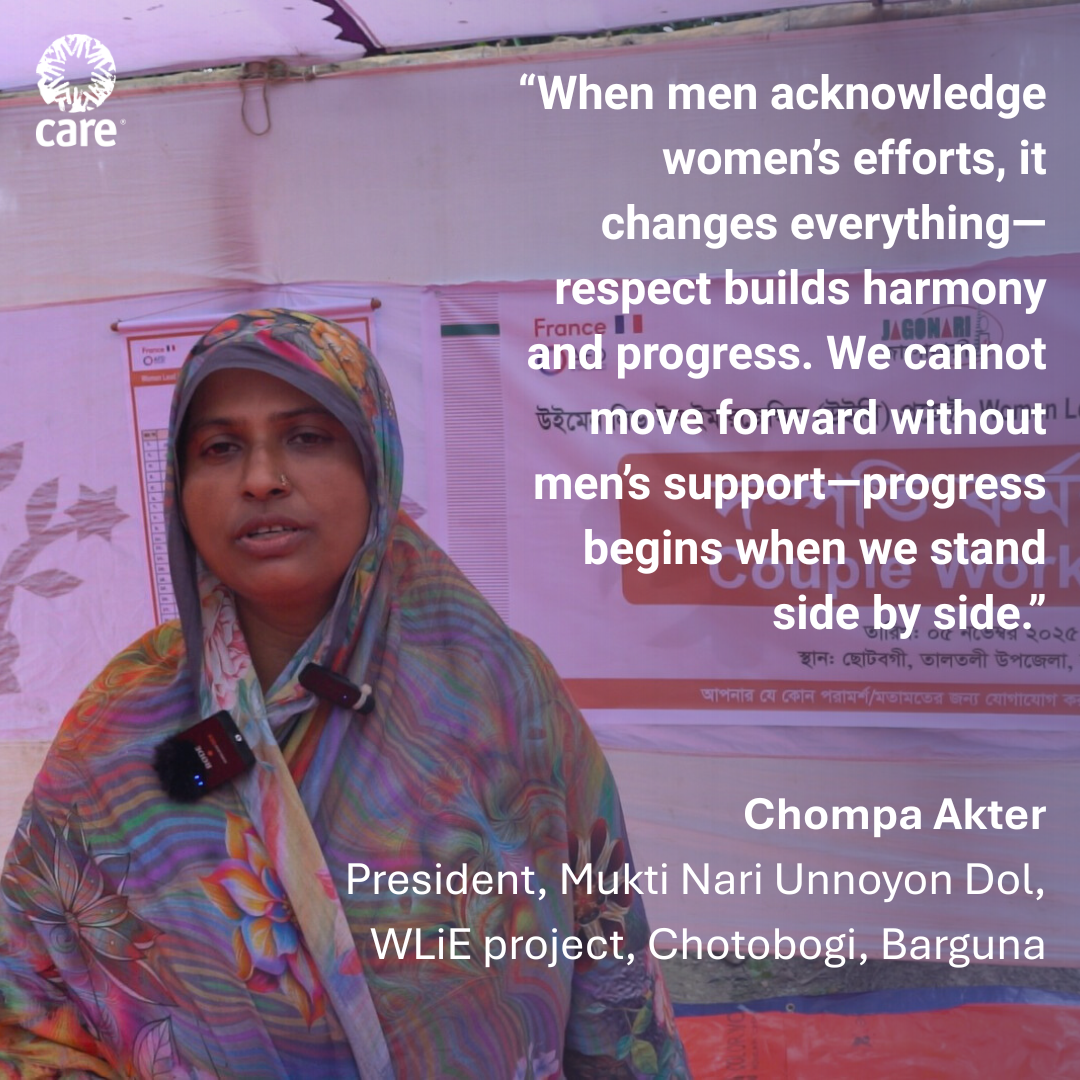 This was a very interesting session which took place near the scenic Payra River. The program participants engaged in a 24-Hour Clock activity. Approximately thirteen pairs of couples, divided into men’s and women’s, mapped their daily routine activities on a large paper, where each hour was indicated like a clock. Once the mapping was complete, the results highlighted the stark disparities: women’s schedules were dominated by household chores, childcare, and elder care, leaving little time for rest or recreation. Men, in contrast, reported more leisure time after work. This imbalance sparked discussions on redistributing responsibilities and creating space for women’s well-being, with some of the men stating their participation in sharing the burden of household chores, while others have come forward. Such conversations are critical for challenging the norms and promoting shared responsibilities within households.
After the visit, Bénédicte Ginestet said, “Empowering women is not only about achieving gender equality—it is about building stronger, more resilient communities capable of facing climate and humanitarian crises.”
About the Women Lead in Emergencies (WLiE) Project
 The Women Lead in Emergencies (WLiE) project is a four-year, multi-country programme managed by CARE France in partnership with CARE Colombia, CARE Ethiopia, CARE Ukraine, and CARE Bangladesh, with CARE UK serving as the WLiE technical lead and IDS as the research partner. The project aims to increase the participation and leadership of women’s organizations, collectives, and networks both formal and informal in promoting peace and security, as well as in the design and implementation of humanitarian responses.
 The project is financed by the Agence Française de Développement (AFD). Its overall objective is to enhance the effective participation of Women’s Rights Organizations (WROs) and women’s community groups in efforts to promote peace and security and in shaping and implementing humanitarian responses. Visit www.afd.fr/en to learn more about Agence Française de Développement (AFD)
A reputed Women’s Rights Organization, JAGO NARI, is implementing the project. They have strong experience and capacity in working with women’s groups, particularly in climate-responsive interventions. JAGO NARI emphasizes strengthening the capacity of marginalized, climate-vulnerable women to cope with disaster risks through active community engagement.
The recent visit to Barguna reaffirmed a key principle: sustainable progress depends on gender equality. Empowering women is not only a matter of rights but a practical necessity for building resilient and inclusive communities capable of facing future challenges.
All photos by: Priyotosh Das/CARE