

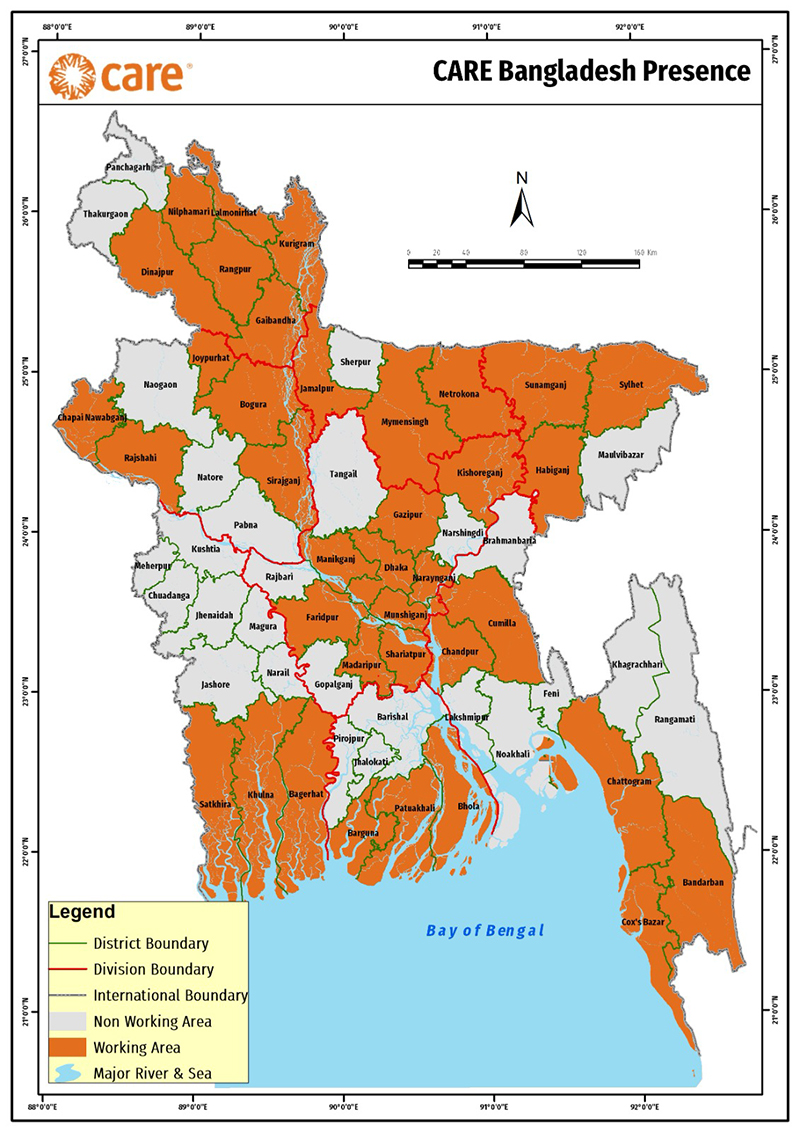

CARE Bangladesh Humanitarian and Resilient Futures Program is implementing the adaptation outcome i.e., Adaptation in Ecologically Critical Areas in Bangladesh (AECAB), of the UK Foreign, Commonwealth and Development Office-FCDO’s flagship Bangladesh Climate and Environment Programme (BCEP) – a key component of the Bangladesh-UK Accord on Climate Change. The project titled ‘Nature Based Adaptation towards Prosperous and Adept Lives & Livelihoods in Bangladesh (NABAPALLAB/ নবপল্লব)’ aims to engage biodiversity and natural resource-dependent communities to strengthen the climate resilience of the two Ecologically Critical Areas (ECAs) – Sundarbans and Hakaluki Haor, conserve biodiversity, and at the same time, diversify and improve people's livelihood through innovative nature-based (NBS) and locally led adaptation (LLA) solutions. The CARE Bangladesh led consortium consists of CNRS, Cordaid, C3ER-BRAC University, Dushtha Shasthya Kendra (DSK), Friendship, Humanity & Inclusion (HI), iDE, and Practical Action.

Ecosystem Restoration
4,367 km² areas under Ecosystem-based Adaptation (EbA) protection and restoration measure.
People Supported
Support 805,627 vulnerable people supported to better adapt to effects of Climate Change.
Climate Resilience
Reach 634,376 people with improved climate resilience
Sustainable Land Management
Bring 7689 hectares under sustainable land management (SLM).
© Copyright 2026 CARE Bangladesh. Powered By Bangladesh Online


